
Creating Cubes
Most cubes are created manually and the data for the cube is loaded via a Process.
Creating a new Cube in Gateway
To create a new Cube using the Gateway frontend.
- Navigate to the Model page.
- Open Cubes and click New Cube.
- Enter a Cube Name
- Select or Create a new Measure Dimension
- Move the non-measure Dimensions you want from Available Dimensions across to Selected Dimensions.
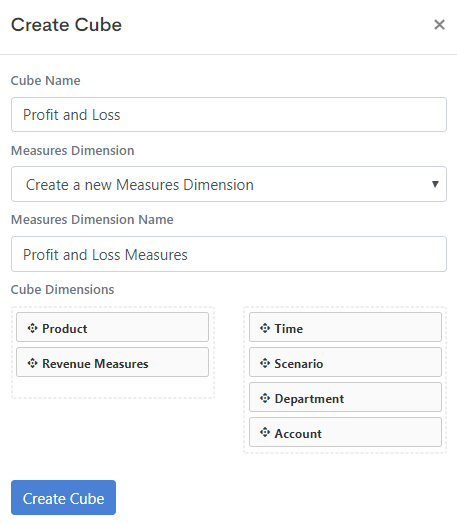
- Click Okay to create the cube.
TIP
If you are creating a new Measures Dimension at the same time you will need to add some elements to this Dimension before you can use or load any data into the cube.
Choosing a Measures Dimension
The Measures Dimension dropdown offers either Create new Measure Dimension or any existing Measures-type Dimension already in the Model, to reuse across multiple Cubes.
Creating a new one is the common case - a Sales cube needs Units, Revenue, COGS and Margin; a Payroll cube needs Salary, Bonus, Super and Total Compensation. These measure sets don't overlap, so each Cube gets its own. Reusing an existing Measures Dimension only makes sense when two Cubes genuinely track the same set of measures but vary along different non-measure Dimensions - which is rarer than it first looks, since most cases that seem to share measures turn out to be a detailed Cube and a summary Cube of the same dataset instead. If in doubt, create a new one - splitting a shared Measures Dimension apart later is more disruptive than merging two separate ones if an overlap is discovered.
Selecting and ordering Dimensions
The dual-panel selector in the dialog excludes Measures-type Dimensions, since those are chosen through the dropdown above instead. Whatever order Dimensions are added to the Selected Dimensions panel is the order they're used in the Cube - the Measures Dimension is implicit and always comes last regardless of what's shown here.
This order is what formulas, Excel CubeGet functions and process functions like cube.set/cube.get are addressed by going forward, though it can be changed later without breaking any of them - see Dimension order. A sensible starting order is typically Scenario and Time near the front, the most-frequently-filtered Dimensions next, and everything else toward the end.
Avoid adding a Dimension speculatively - every Dimension on a Cube is friction it carries forever, showing up in every formula, every Workview and every CubeGet/process call that touches it. See "Over-dimensionalising" in Designing a Dimension.
Modifying a Cube's Dimensions after creation
A Cube's Dimensions aren't locked in once it's created - the per-cube actions menu on the Cubes list has a Dimensions option that opens an interface for adding or removing them. This is genuinely useful, but each direction has real consequences:
- Adding a Dimension means every existing cell now needs a position on the new axis. MODLR defaults existing data to the first Element of the new Dimension, which is rarely the right place for it - plan how existing data should be positioned before adding the Dimension, not after.
- Removing a Dimension consolidates cells that varied along it rather than dropping them outright, but the lost granularity can't be recovered without reloading the source data from scratch.
- Both operations touch every formula, Workview, Process and Excel reference against the Cube. Formulas using
LINKorLINKBYneed reviewing, Workviews may need reconfiguring, and ExcelCubeGetfunctions need their parameter list adjusted to match.
Treat this as a change worth planning for, not a casual fix - reach for it when the Model's design has genuinely shifted, and expect some downstream cleanup afterward.